The Best Dog Breeds for Apartments: 10 Breeds Suitable for Apartment Living
Do you live in an apartment and want a dog but don’t know which breed is best suited for apartment living?
The good news is that you don’t necessarily need a yard to have a happy dog.
Many breeds adapt excellently to apartment life, provided they receive the walks, attention, socialization, training, and care they need.
What’s important is not to choose a dog solely based on size.
A small dog is not automatically suitable for apartment living, and a medium-sized dog can be an excellent companion if it has the right activity level and gets enough exercise.
If you want to buy a puppy, BucuriaCasei can help you choose a breed that fits your lifestyle and find a verified puppy from collaborating breeders.
What does "dog suitable for apartment" actually mean?
Before choosing a breed, you need to think about more than just the size of your home.
A dog suitable for apartment life should be able to:
- adapt to indoor living;
- use up its energy through walks and activities;
- tolerate typical apartment noises;
- be trained not to bark excessively;
- receive enough attention and mental stimulation;
- have a routine that fits the family;
- be properly socialized.
You should also consider how long the dog will be left alone.
A large apartment doesn’t make up for a dog being left alone many hours every day.
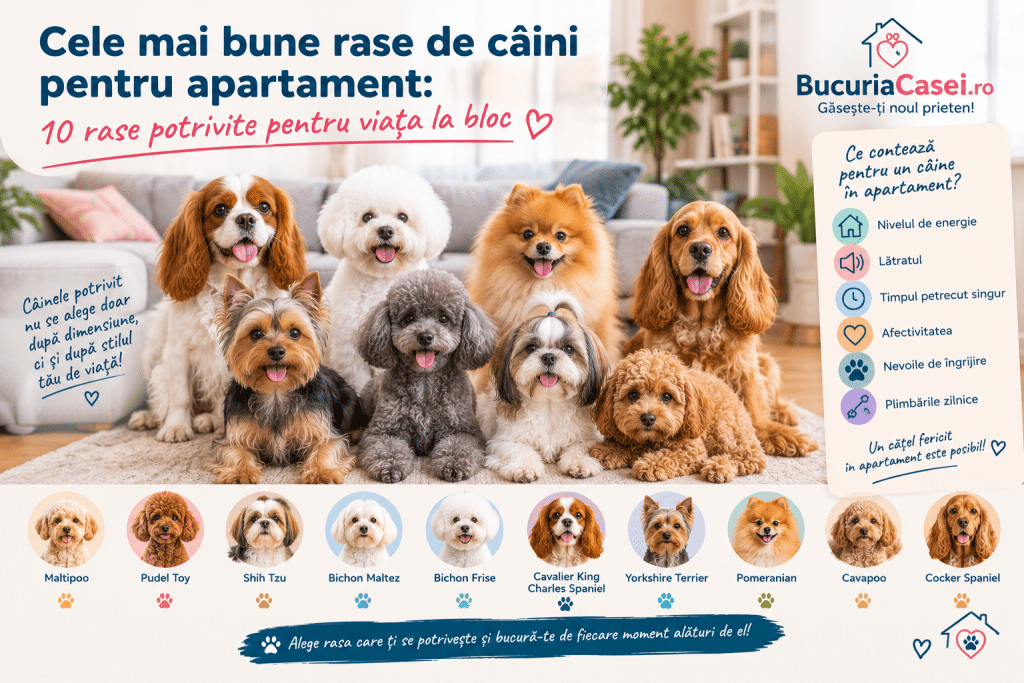
The 10 Most Suitable Dog Breeds for Apartment Living
Below are 10 breeds and types of dogs that may be suitable for apartment living, each with its own advantages and particularities.
1. Maltipoo
Maltipoo It is one of the very popular choices for families living in apartments.
It is a small-sized dog, a cross between a Maltese and a Poodle, valued for its appearance, small size, and family-oriented character.
Why might it be suitable for apartment living?
- small size;
- adapts well to indoor spaces;
- is very attached to the family;
- is intelligent and trainable;
- needs walks but not a large yard;
- can be a good companion for families.
However, Maltipoo has a major drawback: being very attached to people, it may struggle if left alone for long periods.
Therefore, it’s a good choice for someone who wants a dog very close to the family, but less suitable for someone who is away from home many hours each day.
BucuriaCasei even has an article dedicated to whether Maltipoo is suitable for apartments, as well as offers for this category of dogs.
2. Toy Poodle / Caniche Toy
The Toy Poodle is one of the breeds worth considering if you live in an apartment.
It is small, intelligent, very responsive to training, and can be an excellent companion for a family wanting an active but small-sized dog.
Advantages for apartment living:
- small size;
- very intelligent;
- easy to train with suitable methods;
- does not need a yard;
- can adapt well to urban life;
- is suitable for people who want to work with and train their dog.
However, small size doesn’t mean the Toy Poodle doesn’t need activity.
It is an intelligent dog and needs not only walks but also mental stimulation.
Games, obedience exercises, and activities with the family can help keep it from getting bored.
BucuriaCasei has a dedicated page for the Toy Poodle / Caniche Toy, and the company also offers small-sized Poodle variants.
3. Shih Tzu
Shih Tzu It is a classic companion breed and adapts very well to apartment living.
It is a small-sized dog, affectionate and people-oriented.
It doesn’t need hours of running to be happy but does require daily walks, interaction, and stimulation.
Why is it suitable for apartment living?
- small size;
- moderate activity level;
- very attached to the family;
- adapts well to urban life;
- can be suitable for families;
- does not need a yard to expend all its energy.
The main aspect to consider is the coat.
If you want a Shih Tzu with long hair, you must be prepared for regular brushing and grooming.
So, it is small in size but not necessarily "low maintenance."
4. Maltese
The Maltese it is a very popular choice for apartments.
Its small size makes it easy to manage in an urban home, and being a companion dog makes it suitable for people who want a close family companion.
Strengths:
- very small;
- suitable for small spaces;
- affectionate;
- intelligent;
- trainable;
- adapts well to indoor life.
However, you must consider that a Maltese needs attention and interaction.
It is not the ideal choice for someone who wants a dog to stay alone all day.
The long white coat also requires regular grooming.
BucuriaCasei provides a dedicated page for the Maltese Bichon and recommends this breed particularly for people living in smaller spaces.
5. Bichon Frise
The Bichon Frise is another very good choice for urban living.
It is small, sociable, playful, and very people-oriented.
Why can it work well in an apartment?
The Bichon Frise:
- takes up little space;
- can be active indoors;
- enjoys daily walks;
- is sociable;
- trainable;
- adapts well to family life.
However, "suitable for an apartment" should not be confused with "does not need exercise."
Even a small dog needs to be taken outside, socialized, and stimulated.
The Bichon Frise also requires coat care, including regular brushing.
6. Cavalier King Charles Spaniel
If you want a dog slightly larger than a Bichon or Yorkshire Terrier but still very suitable for apartment living, the Cavalier King Charles Spaniel can be an interesting option.
It is known for its affectionate nature and attachment to family.
Why can it be suitable?
- small to medium size;
- very affectionate;
- sociable;
- enjoys people’s company;
- can adapt to apartment living;
- can be a very pleasant family dog.
However, it needs daily walks and activity.
It is not a dog to choose just because it "is small."
Before buying, it is very important to check the health of the parents and the medical history of the line from which the puppy comes.
BucuriaCasei has a dedicated page for the Cavalier King Charles Spaniel and offers advice on choosing the breed suited to the family’s lifestyle.
7. Yorkshire Terrier
The Yorkshire Terrier is probably one of the most well-known examples of a dog suitable for apartments.
It is very small, but its personality can be much bigger than its body size.
Advantages:
- takes up very little space;
- adapts well to urban life;
- easy to carry;
- very attached to its owner;
- can be active both indoors and outdoors.
But there is an important aspect:
The Yorkshire Terrier is not necessarily a quiet dog just because it is small.
It can be vocal and requires training and socialization.
Also, the coat requires care if kept long.
BucuriaCasei presents the Yorkshire Terrier as one of the breeds suitable for smaller spaces and has a dedicated page for the breed.
8. Pomeranian
The Pomeranian is another very popular breed among people living in apartment buildings.
It is small, very expressive, playful, and can be an excellent companion.
What makes it suitable for an apartment?
- very small size;
- does not need a yard;
- can expend some energy through play;
- is intelligent;
- is very attached to the family;
- adapts well to small spaces.
However, there is one thing future owners should know:
The Pomeranian can be vocal.
If not properly trained, it may bark at noises, people, or other animals.
In an apartment, barking training is important not only for the family's comfort but also for neighbor relations.
BucuriaCasei currently has a dedicated page for the Pomeranian and includes it among the popular breeds for apartments.
9. Cavapoo
The Cavapoo is an increasingly popular choice for families looking for a small to medium-sized companion dog.
It is a dog resulting from the crossbreeding of the Cavalier King Charles Spaniel and Poodle.
Why is it attractive for apartment living?
- relatively small size;
- family-oriented;
- sociable;
- intelligent;
- trainable;
- can adapt well to urban life.
However, the Cavapoo needs walks and interaction.
It should not be chosen just for its "teddy bear" look.
As with any other dog, the puppy’s individual temperament and needs must be taken into account.
10. Cocker Spaniel
It may seem surprising to see the Cocker Spaniel on a list for apartment living.
But a Cocker can live very well in an apartment if the family is active.
The problem is not necessarily the size of the apartment.
The problem is lack of activity.
The Cocker needs walks and physical and mental stimulation.
It’s suitable for you if:
- you enjoy taking long walks;
- you go outside regularly;
- you want an active dog;
- you have time for play and training;
- you’re not looking for a dog that stays on the couch all day.
If you provide enough exercise, an apartment can be a great environment for a Cocker.
BucuriaCasei also notes that the Cocker Spaniel can adapt to apartment living, provided it receives the necessary daily physical exercise.
But what is the best breed for an apartment?
There is no universal answer.
The most suitable breed is the one that fits your lifestyle.
For example:
If you want a very small dog:
You might consider Yorkshire Terrier, Maltese, Pomeranian, or Toy Poodle.
If you want a very affectionate dog:
Maltipoo, Shih Tzu, Cavalier, or Cavapoo can be good options.
If you want an intelligent and easy-to-train dog:
The Toy Poodle is a breed to consider.
If you want an active dog:
The Cocker Spaniel may be a better choice than a very sedentary dog.
If you want a dog that is very close to the family:
Maltipoo, Cavalier, Shih Tzu, or Cavapoo can be interesting choices.
A small dog does not automatically mean a dog suitable for an apartment.
This is one of the most common mistakes.
A Chihuahua, Yorkshire Terrier, or Pomeranian can be very small but also very vocal.
A Cocker Spaniel is bigger but can be perfectly happy in an apartment if it receives enough exercise.
So, when choosing, look at:
size + energy + level of vocalization + attachment + exercise needs + family’s available time.
What dog is suitable if you work from home?
If you work from home, the situation is different.
You might consider breeds very attached to people, such as:
- Maltipoo;
- Shih Tzu;
- Cavalier King Charles Spaniel;
- Cavapoo;
- Maltese.
But there is also a disadvantage.
A dog that is constantly with you may have difficulties when you start leaving it alone.
That’s why, even if you work from home, it’s important to gradually teach it to stay alone for reasonable periods.
What dog is suitable for a family with children?
Here, we need to look beyond the breed.
The individual temperament, socialization, and the child’s age matter a lot.
In general, for a family with children, you can consider:
- Cavalier King Charles Spaniel;
- Bichon Frise;
- Poodle;
- Cocker Spaniel;
- Cavapoo;
- Maltipoo.
But a small child should never be left unsupervised with any dog, regardless of breed.
The dog must also have its own space where it can retreat.
Which dogs would I avoid in a very small apartment?
There is no universal list of "forbidden" apartment breeds.
Even large dogs can live in apartments under certain conditions.
However, if the living space is small and the family has little time for walks, choices based solely on appearance should be avoided.
A very energetic dog that needs a lot of daily activity can become difficult to manage no matter how cute it is.
The problem isn’t always space. The problem can be lack of time.
What should you check before buying a dog for an apartment?
Don't stop at choosing just the breed.
Before buying, check:
1. Puppy’s age
The puppy must be mature enough to be separated from the mother and delivered.
2. Health condition
Request information about vaccinations, deworming, and veterinary check-ups.
3. Microchip and RECS
Verify identification and the appropriate documents.
4. Temperament
Ask about the puppy’s behavior, not just appearance.
5. The parents
Where possible, request information about the parents and their history.
6. Documents
Check which documents are included in the offer.
7. Transport
If the puppy is in another city, find out in advance how it will be transported.
How can BucuriaCasei help you choose a dog for an apartment?
Sometimes the problem is not that you don’t know which dog you like.
The problem is that you don’t know which dog suits you.
Maybe you like a Husky, but you work 10 hours a day.
Maybe you like a Toy Poodle, but you want a dog to go on long hikes with.
Maybe you like a Shih Tzu, but you want a very active dog.
This is where pre-purchase counseling matters.
BucuriaCasei is not the breeder of all dogs shown on the platform but a pet brokerage agency that works with cooperating breeders.
You can tell the team:
- where you live;
- how big your apartment is;
- how many hours a day you are away;
- if you have children;
- if you have other pets;
- how much time you can dedicate to walks;
- what size you want;
- what budget you have;
- what activity level you are looking for.
Based on this information, you can receive recommendations and puppy options that better match your requirements.
BucuriaCasei currently even features a category dedicated to popular apartment breeds, including Cavapoo, Maltipoo, Cavalier King Charles Spaniel, Toy Poodle, Pomeranian, and Yorkshire Terrier.
Why is it important to choose the puppy, not just the breed?
Two dogs of the same breed can have different personalities.
One can be very energetic.
Another can be calmer.
One can be very sociable.
Another can be more reserved.
That’s why, when choosing a puppy, it’s helpful to receive as much information as possible about it, including recent photos and videos.
BucuriaCasei uses this kind of information in presenting options to clients and provides support in choosing the puppy.
How important is barking in an apartment?
Very important.
Neighbors can tolerate a dog running around inside much more easily than one that barks for hours.
Small breeds can sometimes be very vocal.
For example, Pomeranians and Yorkshire Terriers may tend to alert the family to noises or people.
That does not mean they are unsuitable for apartments.
It means that education and socialization are essential.
How do you help a dog adapt to apartment life?
The first weeks are important.
The dog needs to gradually get used to:
- the elevator;
- the stairs;
- the noises in the stairwell;
- the doorbell;
- the neighbors;
- the cars;
- the traffic;
- other animals;
- people;
- periods when it stays alone.
With patience and positive training, these things can become a normal part of its routine.
Conclusion: which breed do you choose for an apartment?
If you live in an apartment building, you don't have to give up on the idea of having a dog.
There are many breeds that can adapt very well to urban life.
Among the most interesting options are:
Maltipoo, Toy Poodle, Shih Tzu, Maltese, Bichon Frise, Cavalier King Charles Spaniel, Yorkshire Terrier, Pomeranian, Cavapoo, and Cocker Spaniel.
But don't choose just based on the photo or how small the dog is.
Ask yourself:
How much time do I have for walks?
How long will the dog be left alone?
Do I want a calm dog or an active one?
Am I prepared to take care of the coat?
How do the neighbors react to noise?
Do I have children or other pets?
What temperament do I want?
If you answer these questions before choosing, the chances are much higher that the animal will be suitable for your lifestyle.
Are you looking for a dog suitable for apartment living?
Tell the team at BucuriaCasei what your family looks like, how much time you spend at home, what size you want, and what your budget is.
Instead of choosing a dog just because you liked its photo, you can start by identifying the breed and temperament suitable for your life.
BucuriaCasei can help you find puppy options from collaborating breeders, receive photos and videos, get information about the puppies, and manage the purchasing and transportation process to the new family.
Choose the dog that fits your life, not just the one that looks best in a photo.